Are Armenian diplomats enterprising?
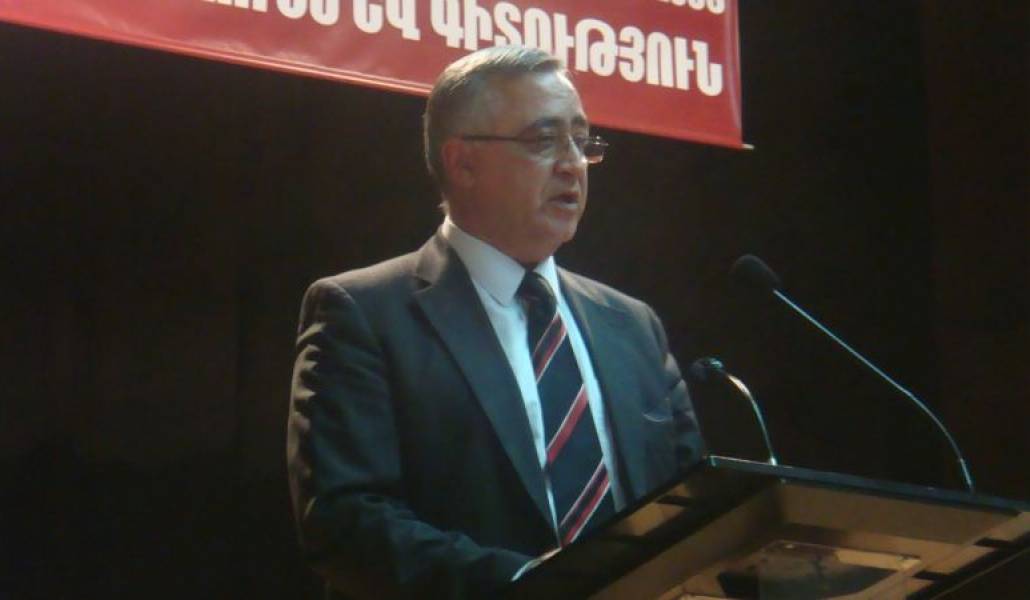
Deputy Minister of Foreign Affairs Sergey Manasaryan gave an interview to "A1+".
"A1+": How would you assess the readiness and efforts of Armenia's diplomatic corpus? :
Sergey Manasaryan: If we speak of that, we must take into account the fact that we didn't have a diplomatic corpus twenty years ago. Of course, the situation has changed because we are seeing a new generation of educated and experienced diplomats and we finally have a diplomatic school that we created through combined efforts. That was a serious step. I took part in the exams and can say that the youth are at a rather high level. Today, we have diplomats speaking more than one language and I see a good future.
"A1+": Can you tell us the percentage of diplomats that have vocational education?
S. M.: It's hard to say, but it's not right to speak of vocational education. If we used to speak of those who graduated from MSIIA (Moscow State Institute of International Affairs-ed.) during the Soviet era, it would be a little wrong to speak of vocational education since most of the best diplomats hadn't graduated from that institute.
"A1+": There is a tradition that the RA President's or the RA Foreign Minister's press speakers move on to diplomatic service after their dismissal. Let us recall Dzyunik Aghajanyan, Vahe Gabrielyan, Ashot Kocharyan and Ara Papyan.
S. M.: Perhaps we could say the opposite. The diplomats commissioned to the presidential apparatus continue to work as diplomats. Vahe Gabrielyan and Ashot Kocharyan are diplomats at the Ministry of Foreign Affairs.
"A1+": Mr. Manasaryan, the granting of a juridical status to national churches in Georgia raised a big wave of protest among Armenians. What is the official Yerevan doing to resist that?
S. M.: It is all a little exaggerated. Of course, there are people who look at the matter differently. According to the Georgian church's official explanations (it didn't only refer to Armenian churches), what happened was the result of the rather high-level relations between the countries and the presidents. Yes, that step led to a big wave of protest among Armenians, but I don't think it is serious and that it will be ongoing.
"A1+": Are you assuring that Georgian-Armenians and Armenians in Javakhk are not in danger?
S. M.: No, there is no and won't be any danger because I hope that Georgia is treating the matter as seriously as Armenia is, and nobody needs further tension.
"A1+": You have been working at the Ministry of Foreign Affairs since 1996. How would you assess Armenia's current policy? There is an opinion that Armenia is passive. Do you think Armenia's Ministry of Foreign Affairs is passive or enterprising?
S. M.: Armenia's foreign policy now has many vectors. I wouldn't say it is passive. Leading a policy in quite a lot of directions is enterprising. In many cases, we try to criticize and not notice the many achievements. I would like to bring up the failure of Azerbaijan's latest initiative as an example. It was a victory. If joint efforts weren't made, we wouldn't have achieved such a result. The current state of the Nagorno-Karabakh conflict is like no other in the past.
"A1+": In what sense?
S. M.: In the sense that the international community accepts Armenia's position.
"A1+": Perhaps Armenia is the one accepting the international community's position.
S. M.: No, let's remember that about six years ago, everyone said the issue of territorial integrity should have been taken out of the proposed document. Who recalls that now? Now they say everything is equivalent and they can't be separated. Isn't that a victory?
"A1+": Wasn't Armenia imposed to sign the Turkey-Armenia Protocols?
S. M.: No, who could have imposed?
"A1+": Super powers.
S. M.: I don't think so. Armenia could have given an evaluation from different angles, but I don't think it was imposed. Those Protocols are in Armenia's interests. We will have an open border and an open road. Turkey showed the world that it isn't ready or tolerant, but I think the opening of the Armenian-Turkish border is a matter of time.
Interview by Diana Markosyan