HONOURING OF OBLIGATIONS AND COMMITMENTS BY ARMENIA
Support A1+!Statement on the visit to Armenia, 3-5 December 2007 by Mr Colombier
Committee on the Honouring of Obligations and Commitments by Member States of the Council of Europe
(Monitoring Committee)
Co-rapporteurs: Mr Georges Colombier, France, Group of the European People's Party and Mr Mimica, Croatia, Socialist Group
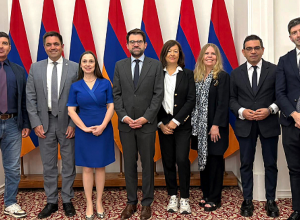
I visited Armenia for the Monitoring Committee from 3 to 5 December 2007 last, accompanied by Mrs Despina Chatzivassiliou, Secretary of the Monitoring Committee. Mr Neven Mimica, the other co-rapporteur, was not able to attend since at the last minute he felt ill.
The purpose of the mission was to verify the implementation of Resolution 1532 (2007) approx. one year after its adoption, half a year after the parliamentary elections (12 May 2007) and 2 months and a half before the presidential elections (19 February 2008).
We met authorities at the highest level (President, Speaker of the National Assembly, Prime Minister, various Ministers etc) as well as NGOs, representatives of the international and diplomatic community, media representatives and presidential candidates.
We received assurances by the President of the Republic, Speaker of Parliament and Prime Minister that an invitation will soon be sent to PACE to observe the presidential elections. An invitation will also be sent to ODIHR with no restrictions on the number of observers. We insisted on the need to receive the invitation as soon as possible and ideally before 17 December, date of the Bureau meeting, so that a pre-electoral mission can be organised for mid-January, prior to the PACE session.
Although the electoral campaign will officially only start on 21 January 2008, the situation in Armenia was quite tense since most candidates had already declared their intention to run for the presidential elections and started their campaign.
The two main contesters are considered to be the current Prime Minister and leader of the Republican Party, Mr Serzh Sargsyan, and the First President of Armenia (1991-1998), Mr Levon Ter-Petrossyan, who has been "self-nominated" (although supported by numerous opposition political parties). We met both. Two candidates come from the National Assembly: Mr Vahan Hovhannisyan (from the Armenian Revolutionary Federation faction which is no longer part of the ruling coalition but has a special co-operation agreement with the latter) and Mr Artur Baghdasaryan (from the Country of Law faction belonging to the opposition). We met Mr Hovhannisyan but not Mr Bagdasaryan who was visiting the regions during our mission. 5 other politicians have submitted their nomination documents to the Central Electoral Committee (CEC) which will examine them and register accordingly candidates by 20 January 2008.
It is the candidature of Mr Levon Ter-Petrossyan, after ten years of silence, that seems to have actually caused an increasing attention to the presidential elections which would have otherwise been considered as won in advance by the candidate of the Republican Party which obtained 49% of the seats in the National Assembly after the May elections.
As regards the main findings of the mission, on the positive side:
Several legislative reforms have been completed notably as regards the judiciary and the Public Prosecutor's Office: following the adoption of the Judicial Code and of the Code of Administrative Procedure, a new judicial structure will start functioning as of 1 January 2008. Investigative powers have been transferred from the Public Prosecutor's Office to the police.
Amendments have also been recently adopted to the Electoral Code as well as to the law on radio and television with regard to the electoral campaign. Although they have not yet been reviewed by the Venice Commission, most interlocutors, notably from the OSCE and IFES, have told us that these amendments present an improvement.
Although we raised once more the necessity of introducing inking to avoid multiple voting, we were told that this proposal had already been rejected by Parliament. Instead, for the same purpose, ID documents will be stamped following an amendment which was accepted as a compromise solution.
However, it is clear that implementation is again the main problem as regards adopted reforms be it in the judiciary or in the field of elections.
To start from the latter, the PACE as well as the Venice Commission, have repeatedly underlined that the Electoral Code, even before the recently adopted amendments, constituted a good basis for conducting free and fair elections if applied properly and in good faith. The May parliamentary elections, although in general positively assessed by the international community, were highly critisised by local observers and the opposition who alleged that the greatest violations took place prior to the election day and were thus not visible to the international observers.
As regards the role of the media, according to the law and assurances we received, there should be equal coverage of the presidential candidates during the official electoral campaign, that is only as of 21 January 2008. However, at present, according to media monitoring conducted by the Yerevan Press Club, there is excessive coverage of the Prime Minister who accumulates this capacity with that of presidential candidate and very negative coverage of Mr Ter-Petrossyan. I insisted that a more balanced access to the public television should be guaranteed for all 9 presidential candidates, at least as of 7 December 2007, when all of them officially submitted their nomination documents to the CEC.
Finally, an issue of concern as regards the forthcoming elections is the use of administrative means of pressure against followers of opposition candidates as well as intimidation and occasionally violence exercised against them by the police (as was for instance the case on 23 October 2007 when supporters of Mr Ter-Petrossyan were beaten by the police while distributing leaflets announcing his next rally).
As regards the implementation of the judicial reform, despite legislative improvements, judicial independence is far from being guaranteed in practice. A worrying recent development is the frequent use of disciplinary proceedings against judges by the Minister of Justice (a former deputy Public Prosecutor).
Moreover, police brutality seems to have risen during the year as confirmed both by the Human Rights Defender in Armenia and the CoE Commissioner for Human Rights. Ill-treatment is widely used in particular as a means to obtain confessions.
The human rights NGOs and media representatives we met all spoke about a deterioration of the human rights situation in the country in 2007.
As regards local self-government, the draft law on Yerevan was passed at first reading while we were visiting the country. It was agreed and apparently approved in Parliament that no second reading would take place before March 2008 and proper consultation with CoE experts.
Last but not least, as regards Nagorno-Karabakh, I raised the issue of the latest statement made by the Co-Chairs of the Minsk Group in Madrid. Most of our interlocutors considered that an important step was taken forward since the co-chairs submitted to the parties an official document and no longer a non-paper summarising their position and the current state of negotiations; this would be the basis for continuing negotiations by the new President of Armenia after February 2008.